Over the past week I have enjoyed exploring and playing several different games in a variety of different learning and subject areas. What have struck me most are the differing levels of participation required by the learner and the amount of fun or enjoyment in playing each game. A game that I enjoyed playing and that I believe meets many of the criteria for what games are meant to do for students is Nature Road Trip, which is found on the PBS KIDS website, https://pbskids.org/games.
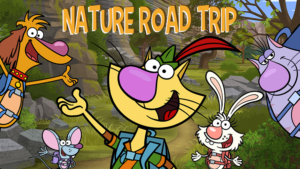
Nature Road Trip is a game about geography and science, focusing on several United States national park sites. The game is appropriate for elementary school children, and from one to five children may play at a time. The students pick a character and then direct that character around a board to different national park sites, collecting rewards and adding to or subtracting from a running cash balance. The board is somewhat similar to the one experienced in the Milton Bradley board game “Life.” One of the most fun parts of the game is shooting various objects within the park sites (geysers, fish, live bats, etc.) to earn points. This part of the game is fast-paced and requires quick reflexes to earn points. A narration instructs the students on the national parks and the importance or significance of the object they are shooting to collect points. This narration connects the fun with the geographical learning objective. I found this game to be both cool and fun with humorous characters, pleasing noises, and colorful graphics. The game is simple for young children to play, and has the advantage of being multiplayer. Though students play for points and reward emblems, there is limited competition between the children, as the point total and rewards board are a collaborative effort. The only competition is to see which character makes it “home” first, as students direct their character around the board with a spinner and choice of directions at multiple junctions. If the teacher wants to bring in some competition beyond this, he or she could have students or teams play each game consecutively and then compare their final point tallies. However, within each separate game competition is not the most important goal, but collaborative geographical and scientific learning is. One of the things I like about this game is that it introduces and defines words simply that the teacher may later build upon, such as geyser, volcano, lava, brine, etc. The only negative of this game for me was its limited use of highlighted, spelled-out words. The narration could have been paired with spelling of introduced words to create some word recognition in the students. Overall, I believe that Nature Road Trip would be an easy, amusing, and enjoyable game for elementary school children to play and learn some basic geographical and scientific terminology.
 Conrad's Blog
You must be logged in to post a comment.