Urbanology Online is described by The Atlantic magazine as “an online game to teach users about sustainability.” Intrigued by this description I played the game, which is actually an interesting series of Yes/No questions (10 per each session) that students answer about critical issues facing modern urban areas, in terms of eight important variables: innovation, transportation, health, affordability, wealth, lifestyle, sustainability, and livability. The student is hypothetically creating his/her ideal future city based on his/her values.
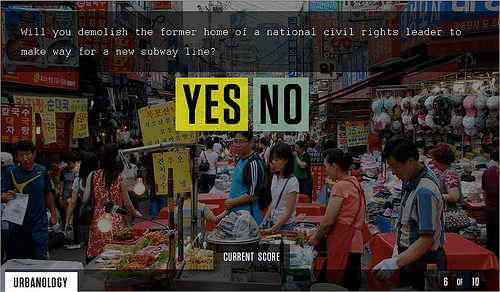
The 10 questions focus on tradeoffs between important variables, such as wealth versus transportation. A typical question reflecting this particular tradeoff is: “A movie company offers your city a great deal of money to film in your subways, but half of the subway lines will be closed during the filming. Would you agree to this?” After answering 10 such Yes/No questions, the student is informed about which modern urban area fits most directly with his/her choices for a future city. I played the game numerous times and most frequently received the answers Singapore, Berlin, and Abu Dhabi. Students may give their future city a name if they choose to do so.
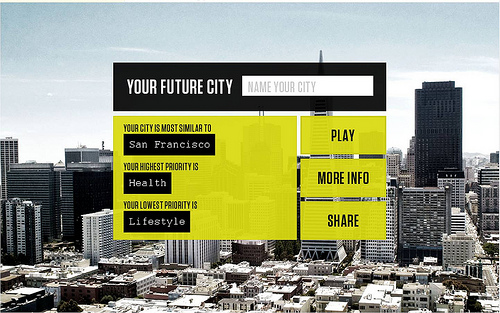
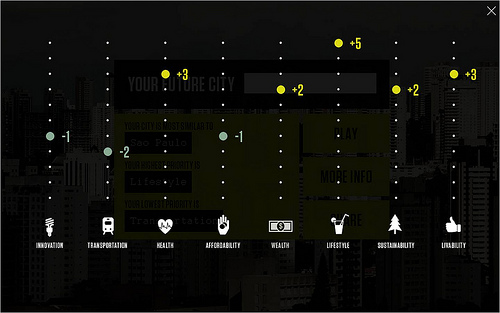
The results page also provides students with a “More Info” tab to see how their answers ranked on a list of the eight variables being measured:
The game was developed by the BMW Guggenheim Lab in New York City. I found the term “video game” to be a strange description for what is an interesting series of questions that students answer. In reality, Urbanology Online is more of a survey than an actual video game. However, as a future teacher of high school social studies, I do believe this game may have some benefit for students as an enjoyable and short supplement to a lesson on the environment or sustainability issues in regard to the world’s cities. Students may also gain valuable insights about the tradeoffs that urban planners regularly have to make between economic wellbeing, environmental protection, care for the disadvantaged, and ease of travel, among other variables. The game does not offer an actual score to players, though the words “current score” appear at the bottom of the question screens. The game is a one-player event, though students could compare the different cities their choices most resembled and see which values ranked higher or lower for them than for their classmates. This is a thoroughly close-ended game, as the player accepts the game developer’s paradigm or goal to learn about the difficult tradeoffs facing modern urban areas. The game does not allow customization, co-design, or cross-functional affiliation. The game does have a socially responsive theme, as students must often weigh one socially or environmentally desirable option against another such beneficial choice. The game does have an ideological framework reflected in its questions, based primarily upon environmental protection, mitigation of climate change, use of mass transportation, and universal health care. The players make moral choices that have social and political ramifications in their desired future cities.
 Conrad's Blog
You must be logged in to post a comment.