One of the video games that I have most enjoyed discovering and playing is Win the White House, an iCivics game that I find truly engaging and useful for my future students in both U.S. government and history classes, especially in presidential election years. The game allows students to first build their own presidential campaign by choosing the candidate’s name, physical appearance, home state, political party, issue positions, and primary slogan. Then the game takes students through the party primaries, the political conventions, and the 10-week stretch to Election Day. Win the White House has colorful graphics and animation, interesting sound effects, and helpful narrative commentary, as well as maps of the United States that assist students in making choices on how to get their candidate to 270 electoral votes through the use of polling, media buys, travel, issue positions, and fundraising. The students also select their candidate’s five key issues from a list of 14 major issues relevant to the political party of their candidate. Students may also choose to run on one issue position generally seen as being championed by the other political party. For instance, once I had a Republican candidate who emphasized immigration reform, and another time I had a Democratic candidate who favored gun rights.

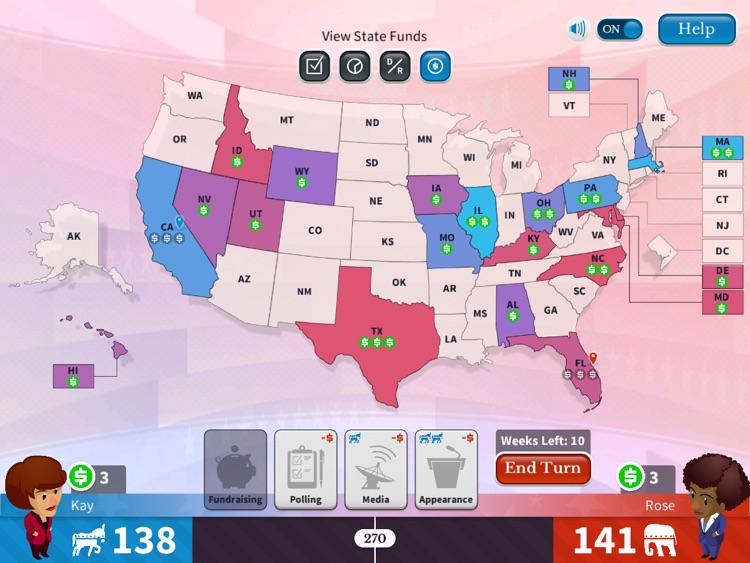
From the beginning, students are provided with options to shape their identity in the game, though the list of possible issue positions is limited, and students have to choose an animated character to represent them. Yet, this does allow some customization of the player’s presidential candidate to fit his/her personal preferences. The game is well-ordered, moving from campaign set-up through the party primaries to the political party conventions and on to the autumn campaign through Election Day. Students have to strategize how they will spend their resources and which states to focus upon during the general election. Memory is a key component to this game, as players must remember which states are leaning to which candidate and which issue positions are popular in the different states. A colorful national map lets students know which states need to be polled and which states have money available for fundraising trips. Players must also decide where to make personal appearances and to purchase media advertising.
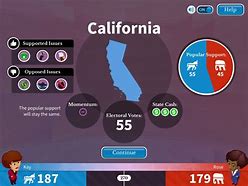
By clicking on individual states students are able to see the current polling percentages for the candidates and which issues are most salient to the voters of that state:
Win the White House is a game filled with choices and action, relying on some strategy and memorization to win the game against the opponent from the other political party. This game allows only one player at a time, though students may compete to see who can earn the highest number of electoral votes or impact points. The game has three levels of difficulty (elementary school, middle school, high school) that are chosen by the player at the beginning. The game is fun to play but may take anywhere from 45 minutes to one hour to complete, assuming that the student chooses to run in the party primaries, which he or she may opt out of in order to save time, going straight to the autumn campaign. Because of the length of time to play this game, I imagine I would have students play the game only once in the classroom and then later at home as an enjoyable activity to learn more about the presidential election process. In this game there is not a set of multiple rewards, as the goal is to obtain 270 electoral votes to win the election. Players who win the election receive a certificate that they may print.
 Conrad's Blog
You must be logged in to post a comment.