Video Game Review 2 – Urbanology Online

Urbanology Online is described by The Atlantic magazine as “an online game to teach users about sustainability.” Intrigued by this description I played the game, which is actually an interesting series of Yes/No questions (10 per each session) that students answer about critical issues facing modern urban areas, in terms of eight important variables: innovation, transportation, health, affordability, wealth, lifestyle, sustainability, and livability. The student is hypothetically creating his/her ideal future city based on his/her values.
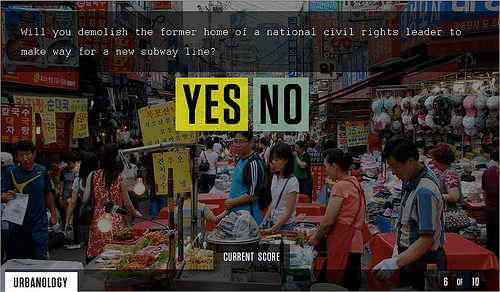
Typical question

The 10 questions focus on tradeoffs between important variables, such as wealth versus transportation. A typical question reflecting this particular tradeoff is: “A movie company offers your city a great deal of money to film in your subways, but half of the subway lines will be closed during the filming. Would you agree to this?” After answering 10 such Yes/No questions, the student is informed about which modern urban area fits most directly with his/her choices for a future city. I played the game numerous times and most frequently received the answers Singapore, Berlin, and Abu Dhabi. Students may give their future city a name if they choose to do so.

Results page

The results page also provides students with a “More Info” tab to see how their answers ranked on a list of the eight variables being measured:
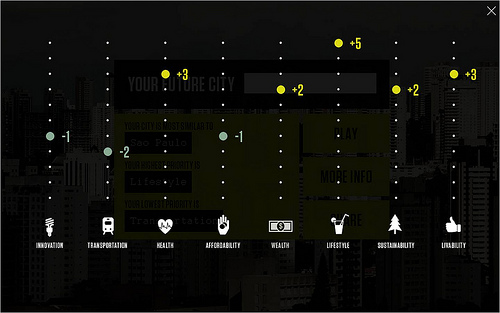
Values/Variables

The game was developed by the BMW Guggenheim Lab in New York City. I found the term “video game” to be a strange description for what is an interesting series of questions that students answer. In reality, Urbanology Online is more of a survey than an actual video game. However, as a future teacher of high school social studies, I do believe this game may have some benefit for students as an enjoyable and short supplement to a lesson on the environment or sustainability issues in regard to the world’s cities. Students may also gain valuable insights about the tradeoffs that urban planners regularly have to make between economic wellbeing, environmental protection, care for the disadvantaged, and ease of travel, among other variables. The game does not offer an actual score to players, though the words “current score” appear at the bottom of the question screens. The game is a one-player event, though students could compare the different cities their choices most resembled and see which values ranked higher or lower for them than for their classmates. This is a thoroughly close-ended game, as the player accepts the game developer’s paradigm or goal to learn about the difficult tradeoffs facing modern urban areas. The game does not allow customization, co-design, or cross-functional affiliation. The game does have a socially responsive theme, as students must often weigh one socially or environmentally desirable option against another such beneficial choice. The game does have an ideological framework reflected in its questions, based primarily upon environmental protection, mitigation of climate change, use of mass transportation, and universal health care. The players make moral choices that have social and political ramifications in their desired future cities.
Video Game Review 1 – Recycle Roundup

I have enjoyed over the past week playing a number of video games requiring differing levels of skill and engagement. One of the more simple and fun games I played is “Recycle Roundup” which is found on the National Geographic Kids website, https://kids.nationalgeographic.com/games/. This website has a number of video games appropriate for younger children, especially students in elementary school. The National Geographic Kids games focus on science, nature, and animals. The website also includes quizzes for students to test their knowledge on a variety of different topics.

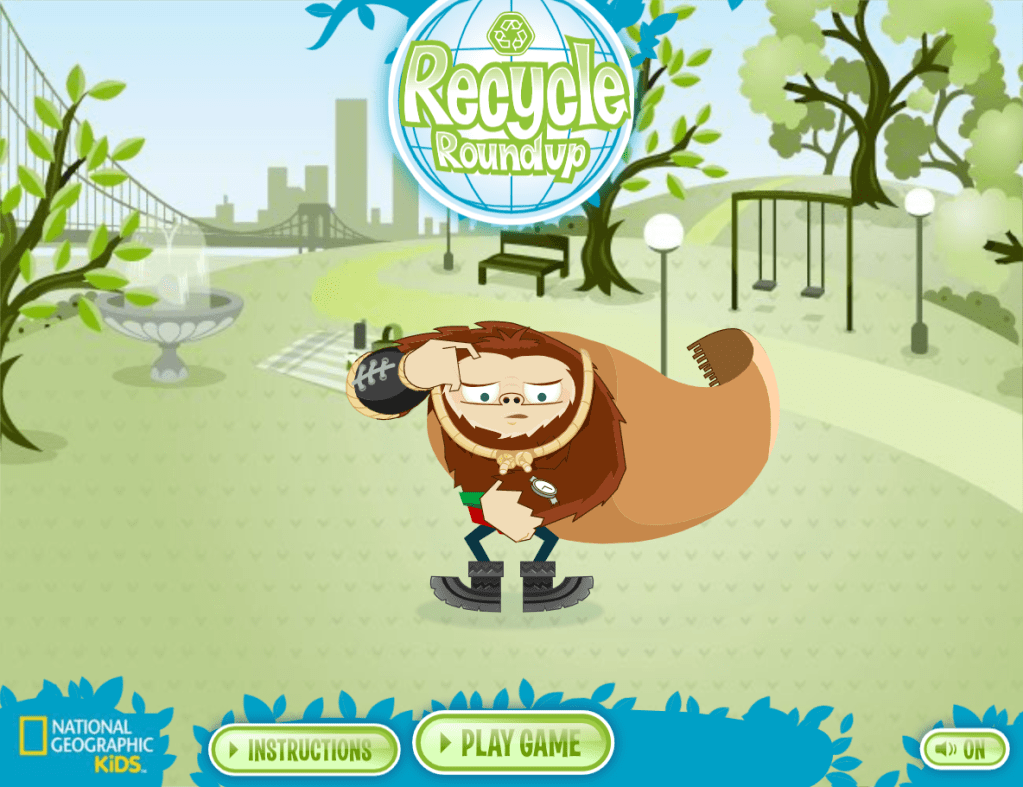
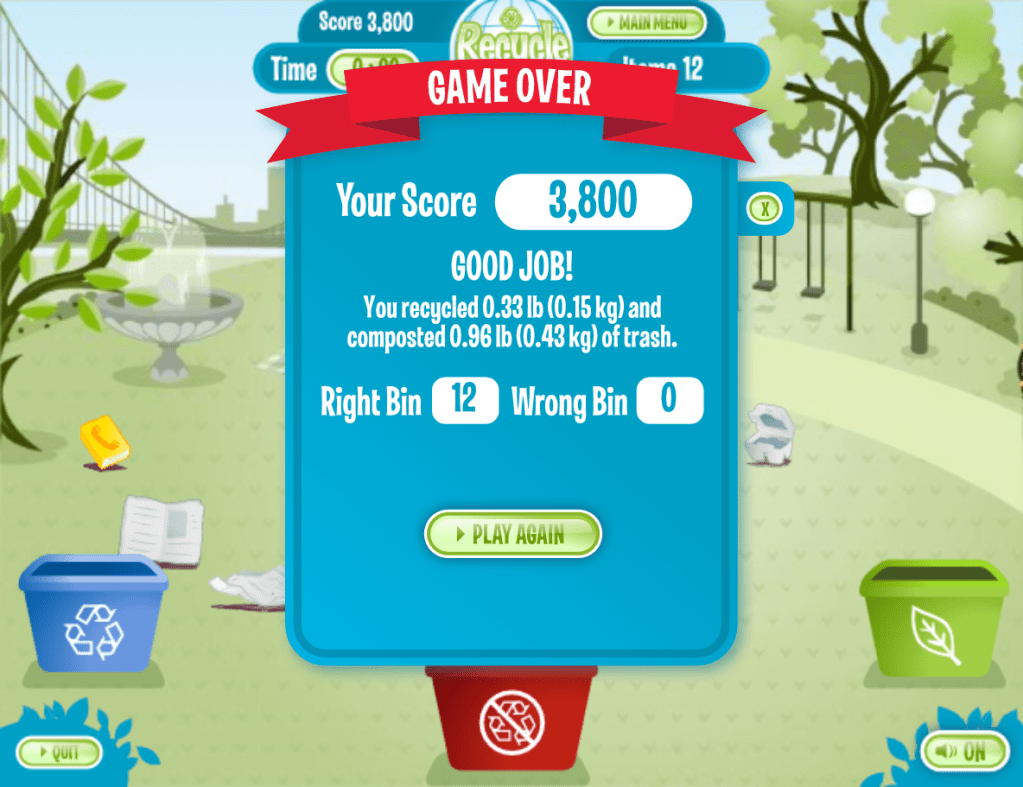
Recycle Roundup, https://kids.nationalgeographic.com/games/action-adventure/article/recycle-roundup-new, is a fun and engaging video game for younger students. The game has a socially conscious environmental theme for student learning, with colorful graphics and cheerful music. The game is single-player and requires players to direct Gus the Gorilla to pick up various items in a public park that may or may not be recyclable or compostable and to place them in one of three containers: 1. Blue (recyclable items: cans, bottles, paper, cellular phones, cardboard); 2. Green (compostable items: banana peels, leaves, carrots, teabags, eggshells); or 3. Red (trash/non-recyclable items: broken dishes, empty toothpaste tubes, used diapers). Some items may be either recycled or composted. Players earn points by placing items in the correct containers. The game lasts for two minutes, and at the end the game informs the player how many items were put into the correct or incorrect containers, and how many pounds or kilograms the player had Gus the Gorilla recycle or compost. Depending on how well the player did, a message will be given at the end, such as “Fantastic Job!” or “Good Job!”

The game is fast-paced and relies on a student’s speed and accuracy, so quick thinking and fast reflexes are essential to earning higher scores. Though the game is single-player, students can compete by comparing their individual scores on the game. I found the game fun and easy to play with lively graphics and animation. The game provides simple instructions for players. This game would be well-used as a supplement to a classroom unit on the environment and the importance of recycling and composting. Even students not particularly interested in environmental topics will enjoy learning about recycling and composting through this video game with its lively animation, graphics, and music.

As a video game primarily directed toward younger students, “Recycle Roundup” does not offer players opportunities to co-design the game. The game is close-ended, with no opportunities for student customization or for progressive, more challenging levels of the game. The game has no smart tools or moments for collaboration with other students. Yet, video games should be fun and appealing for students, and on this basis “Recycle Roundup” succeeds in giving younger students an enjoyable activity as they are learning about the importance of protecting the environment.

Introduction – Spring 2022

Hello! My first name is Conrad, which is my religious name within my monastery community, St. Andrew Svorad Abbey. I also go by Father Conrad, as I am a Catholic priest. I am originally from Atlanta, Georgia, though I have lived in the Cleveland area for over 10 years. Besides praying, chanting, and singing, which are some of the principal duties of a monk, I love to read about British and Irish history, watch vintage television sitcoms, college football and European soccer, and try different types of cuisine. I enjoy foreign and independent movies, so the Cedar Lee Theater is one of my favorite places in the Cleveland area. I tend to follow politics and current global events with great interest. I am the business manager for my monastery, so I devote a great deal of my time to financial matters, which draws upon the almost 20 years I spent in pension plan accounting and administration before I entered consecrated religious life. I am excited this semester to continue to do observations in a high school classroom, though I am not yet certain where this will occur.

For me to take intellectual and creative risks in a course I must have confidence that the instructor will be available if I make a major mistake or fall behind my classmates. As an older man, compared to most of the other students at John Carroll University, I find myself frequently intimidated and overwhelmed by much of the technical language and technological applications with which many other students already have great familiarity. Much of the jargon within the education department also has taken some effort to thoroughly comprehend and incorporate into my vocabulary. I am a determined student, but I sometimes become easily frustrated when the pace of learning is not in sync with my expectations or capabilities.

As a preservice teacher of American history for high school students, I am always interested in ways to teach history in a fuller, more encompassing manner that includes different perspectives than those given by either the classroom textbook or the accepted consensus of most well-known historians. To that end, an essay that speaks to my interests for my future students’ learning is “A History in Which We Can All See Ourselves” by Holly Korbey (Korbey, H. (2018). A history in which we can all see ourselves. https://www.edutopia.org/article/history-which-we-can-all-see-ourselves). As the United States becomes more diverse ethnically, religiously, and in other ways, students need to see themselves and their families represented in the history lessons taught in American classrooms. Many wonderful tools exist to help teachers bring varying perspectives into the classroom and to encourage students to bring their own backgrounds, knowledge, and creativity into class discussions, group collaborations, and individual work. While including various perspectives may involve stark differences of opinion on contentious historical and contemporary subjects, students should learn how to state how their opinions with both conviction and factual evidence, as well as developing the ability to disagree with dignity and respect for those with differing viewpoints.

A question I have about this class is whether apps will need to be purchased or, when possible, picked up free of charge. I have no experience with using apps on my cell phone, so I would need some assistance to understand the process of acquiring apps for use in this class.

Field Observation II: Access to Technology

I have been doing my school technology observations for ED 586 (Educational Technology) at Cleveland Benedictine High School.  I spoke to Mr. Richard Salem, the director of educational technology at Benedictine, about the use of technology with students, teachers, and administrators in order to answer the following questions.

1. Who are the people at your school in charge of the technologies available to advance the learning of students? Identify as many of these people as possible:

  • Director of educational technology: Mr. Richard Salem
  • Curriculum technology integration specialist: Mr. Richard Salem
  • Technology maintenance?: Mr. Richard Salem
  • Technology security personnel: Mr. Richard Salem
  • Library media specialist: Dr. Elizabeth Salem
  • Others?: All teachers have the ability to limit access to Internet or particular websites to students during a specific class period.

2. Details of what technology is available, where it’s located, quantities of technologies (i.e. is there a classroom set of iPads for the students to work with)?

Benedictine High School has a one-to-one technology system with each student having a Windows laptop computer that is used for work both at school and at home.  The students use PlusPortals, Google Classroom, and Schoology to complete and track their assignments.  All teachers have Smartboards within their classrooms.  While many students have personal iPads and iPhones that they bring to school with them each day, these are not part of the school technology resources.

3. Are the technologies readily available and are they in working order?  How do students and teachers gain access? Is there a means for reserving them? Are there required purchases by families?

Technologies at Benedictine High School are readily available and in working order, as each student has his own laptop computer for school and home usage, and Mr. Richard Salem monitors computers to assure they are in working order.  Every student computer comes with accidental damage protection in case of damage or loss.  Parents are required to purchase a laptop computer from the school for their sons from as part of the school tuition payment.  All teachers, administrators, and students have required training when first issued a laptop computer by the school.

4. What is the nature of the firewall blocking access to applications? Is there a process to transcend or move around the firewall? Who is in control? What is available and what is blocked and why?

The Internet Service Provider (ISP) for Benedictine High School is Connect, and the school uses GoGuardian to monitor and control student usage.  The GoGuardian firewall blocks pornographic content, as well as specific video games based on their ratings.  Teachers and administrators may transcend or move around the firewall through the use of a password supplied by Mr. Richard Salem who is in charge of technology security.  As noted, all teachers have the ability to limit access to the Internet or particular websites to students during a specific class period.

Storyboard for My Place in Monastic History

STORYBOARD #1

IMAGE: Exterior shot of St. Andrew Abbey

VOICEOVER: “St. Andrew Abbey in the heart of Cleveland, Ohio is a monastery of 25 Benedictine monks living, working, and praying together under the Rule of St. Benedict.” 

SOUNDTRACK: Stirring organ music.

STORYBOARD #2

IMAGE: Photo of Father Conrad in monastic habit

VOICEOVER: “I, Father Conrad, am one of the monks of St. Andrew Abbey, but where did Benedictine monks come from, and how did I end up as one of them?”

SOUNDTRACK: None.

STORYBOARD #3

IMAGE: Iconic image of St. Benedict of Nursia

VOICEOVER: “It all started about 1,500 years ago in Italy with a man named Benedict of Nursia who founded a place called a monastery for men who wanted to live a life dedicated to God through prayer and work, while living in a community with others who shared the same goal.” 

SOUNDTRACK: Gregorian chant.

STORYBOARD #4

IMAGE: Photo of the Rule of St. Benedict

VOICEOVER: “Benedict wrote a guideline for how monks are to live together, known as the Rule of St. Benedict, which monks follow to this very day.”

SOUNDTRACK: None.

STORYBOARD #5

IMAGE: Exterior shot of St. Vincent Archabbey

VOICEOVER: “Due to Saint Benedict and the monks who came after him, monasteries spread throughout Europe and, eventually, to North America.  The first Benedictine monastery in the United States was opened in 1846 in Latrobe, Pennsylvania by a group of monks from Germany.  That monastery, St. Vincent Archabbey, today has over 160 monks.”

SOUNDTRACK: None.

STORYBOARD #6

IMAGE: Exterior shot of the Monastery of the Holy Spirit

VOICEOVER: “So how did I get interested in monks?  Well, I grew up in the State of Georgia not far from a monastery that my father and I would visit sometimes when I was a boy.”

SOUNDTRACK: Instrumental Southern music.

STORYBOARD #7

IMAGE: Interior shot of chapel of the Monastery of the Holy Spirit

VOICEOVER: “Their chapel was a beautiful place that seemed really large and almost magical to my eyes.” 

SOUNDTRACK: None.

STORYBOARD #8

IMAGE: Photo of monks in procession

VOICEOVER: “The monks seemed like such mysterious figures to me because they were very quiet, they were dressed in robes, and they were always praying the rosary or reading from the Bible.”

SOUNDTRACK: Somber chant.

STORYBOARD #9

IMAGE: Photo of Father Anthony Delisi

VOICEOVER: “Until one day I spoke to one of the monks, Father Anthony.  He smiled at me and said ‘Hello!’  I didn’t know they could talk, let alone smile!  We talked for several minutes and he told me about his job making the chocolate fudge that the monks sold to support themselves.  I learned that monks not only pray but do real work too, like other people.”

SOUNDTRACK: Light, cheerful instrumental music.

STORYBOARD #10

IMAGE: Photo image of “Ora et Labora”

VOICEOVER: “From Father Anthony and my repeated visits to his monastery over the years, I came to respect and admire those who would leave life in the outside or regular world and join a community of likeminded people who wanted to grow closer to God through a life of prayer and work.  In fact, the Benedictine motto is ‘Ora et Labora’ – Pray and Work.”

SOUNDTRACK: None.

STORYBOARD #11

IMAGE: Photo of the monks of St. Andrew Abbey, including Father Conrad

VOICEOVER: “Many years later I made the decision myself to join a monastery.  St. Andrew Abbey was founded in 1922 by immigrants from the Central European country of Slovakia.  We monks pray together four times a day, and our work is centered on teaching and service at Benedictine High School.  As St. Andrew Abbey approaches its 100th anniversary, I am happy to be part of this community of faith in the heart of Cleveland.”

SOUNDTRACK: Slovak traditional music.

My Place in Monastic History

St. Andrew Abbey in the heart of Cleveland, Ohio is a monastery of 25 Benedictine monks living, working, and praying together under the Rule of St. Benedict.  I, Father Conrad, am one of the monks of St. Andrew Abbey, but where did Benedictine monks come from, and how did I end up as one of them?

It all started about 1,500 years ago in Italy with a man named Benedict of Nursia who founded a place called a monastery for men who wanted to live a life dedicated to God through prayer and work, while living in a community with others who shared the same goal. Benedict wrote a guideline for how monks are to live together, known as the Rule of St. Benedict, which monks follow to this very day.

Due to Saint Benedict and the men and women who came after him, monasteries spread throughout Europe and, eventually, to North America.  The first Benedictine monastery in the United States was opened in 1846 in Latrobe, Pennsylvania by a group of monks from Germany.  That monastery, St. Vincent Archabbey, today has over 160 monks.

So how did I get interested in monks?  Well, I grew up in Atlanta, Georgia not far from a monastery that my father and I would visit sometimes when I was a boy. Their chapel was a beautiful place that seemed really large and almost magical to my eyes. The monks seemed like such mysterious figures to me because they were very quiet, they were dressed in robes, and they were always praying the rosary or reading from the Bible.

Until one day I spoke to one of the monks, Father Anthony.  He smiled at me and said ‘Hello!’  I didn’t know they could talk, let alone smile!  We talked for several minutes and he told me about his job making the chocolate fudge that the monks sold to support themselves.  I learned that monks not only pray but do real work too, like other people.

From Father Anthony and my repeated visits to his monastery over the years, I came to respect and admire those who would leave life in the outside or regular world and join a community of likeminded people who wanted to grow closer to God through a life of prayer and work.  In fact, the Benedictine motto is ‘Ora et Labora’ – Pray and Work.

Many years later I made the decision myself to join a monastery.  St. Andrew Abbey was founded in 1922 by immigrants from the Central European country of Slovakia.  We monks pray together four times a day, and our work is centered on teaching and service at Benedictine High School.  As St. Andrew Abbey approaches its 100th anniversary, I am happy to be part of this community of faith in the heart of Cleveland.

Field Observation I: AP U.S. History Student Observations

For the past three weeks I have been observing Father Michael Brunovsky’s 4th Period 11th grade AP U.S. History class at Benedictine High School in Cleveland. The students are quite engaged in the material, and Father Michael uses several different media to capture and hold student interest during the class. In addition, students not only are rather savvy with their personal IPhones and IPads, but they readily access class material on the class web portal, as well as through an AP U.S. History website (ap.GilderLehrman.org) that helps students to prepare for the upcoming AP exams, which will take place in May of this year for these students. Today, the AP U.S. History exam is a three to four hour written examination, consisting of multiple choice questions and essays, whereas I can remember a much more simple multiple choice AP U.S. History exam I took in the early 1980s. Thus, Father Michael works not only on content but on how students need to present such content in a coherent fashion in well-formed essays.

The classroom I am observing seems more similar to classrooms I attended during high school in the 1970s and 1980s than some of the newer examples I am encountering during my education studies at John Carroll University. The desks are traditional and stationary, not conducive to group work. However, they are arranged in a semi-circle so that all students are close to the front of the class. Father Michael lectures during class, but uses a variety of technology and media, such as a Smartboard for PowerPoint slides, YouTube videos, DVDs, as well as music and spoken language CDs and other media to provide variety in presentation formats. His lectures involve much input from students, ample time for questions and answers, and some discussion and debate among students about the topics for the day. However, Father Michael frequently has to bring students back to the main topic when some of their side conversations veer into debates and arguments about contemporary politics, high school sports rivalries, teenage romance gossip, and other subjects not germane to U.S. History.

All students at Benedictine High School have laptop computers courtesy of the school, which they can take home at night for homework assignments. The young men in Father Michael’s class keep their computers open throughout class to follow along with his PowerPoint slides, which he publishes on the class web portal. Students either take notes on their laptops or in paper notebooks, depending upon their personal preference. Father Michael posts other relevant class documents on this portal for student reading outside of class. Students may turn in assignments by email or by hand, and Father Michael returns much of their graded work by email. However, class exams are written on paper in class. Father Michael is not yet ready to offer exams online, as he notes that even the AP exams are not online, though he points his students to practice AP exams online for their benefit. In addition to posted materials online, the students have a traditional hardback textbook, The American Pageant, as the primary source for reading, homework questions, and review for tests.

The students in AP U.S. History do much of their essay writing and other homework online to turn in to Father Michael by email, and he notifies them by email when he has posted something new to their class web portal, such as assignments and documents for them to read or videos for them to watch. All of the students feel very comfortable using technology on their laptop computers, IPhones, and IPads for this purpose. Student IPhones sometimes become a source of contention in class when students are using them to text other students or look up material that is not class related. Worse, students sometimes use their phones to film other students, which is against school policy. Father Michael often has to remind his students about the rules regarding cell phone usage in class and in school.

Father Michael does not use video games for this class, though I showed him the Mission US website to see if he thinks his students might get some use out of it. His students all have favorite video games, some of which they will play in study hall and during lunch. However, most of these games are for personal enjoyment rather than for class work. The young men do enjoy video games where two or more of them can play at the same time on their individual cell phones or laptop computers. As I am a study hall monitor for three periods per day at Benedictine High School I can attest to hearing the excited cries of the students when playing these games. Yet, it seems that most students are not doing much with video games for education, though I am aware that one of the math teachers uses a number of online math games in his class.

The students in 4th period AP U.S. History do not collaborate on group projects, as all of their writing is personal. However, Father Michael encourages creativity in their writing, allowing them to use political cartoons, YouTube videos, relevant music, and photos to bring out the historical period they are attempting to convey. The students have recently been studying the Jazz Age of the 1920s, and there was a great discussion in class about different musical styles and popular artists of that period. The students had great familiarity with the material from their personal writing and insights on the topic. Though history does not usually allow as much self-expression as English Language Arts for most students, Father Michael encourages the young men to offer and express their opinions about the controversial issues of the past surrounding U.S participation in World War I, the New Deal, and World War II. The students particularly connect with music and videos from those time periods, which they can readily access on their technological devices to make U.S. History much more interesting and enjoyable.

The implications of digital storytelling and multimodal composition for AP U.S. History students at Benedictine High School in the class I have been observing are not fully realized at this time, as the students are not putting together videos for class presentations, as this class is lecture and teacher-centered. Students do have the opportunity to offer some multimodal composition in their work to be handed into the teacher by email or by hand. However, I could see asking my future students to prepare their own digital stories for presentation to the class, and ask them to really put themselves into the material, using their own historical interests as a basis for putting together a multimodal composition that will really grab their enthusiasm and then present the composition to the class as a digital story for students to engage with and ask questions.

Video Game Review – Dung Beetle Derby

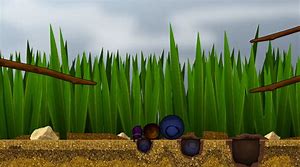
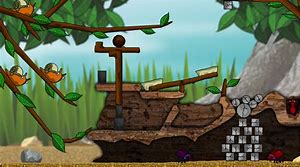
The National Geographic Kids website, https://kids.nationalgeographic.com/games/, has several video games with a scientific focus that are appropriate for elementary school aged children.  I played several of the games and found “Dung Beetle Derby” to be both challenging and fun to play, https://kids.nationalgeographic.com/games/action-and-adventure/dung-beetle-derby/. The game has physics puzzles that need to be solved such that a dung beetle may move a ball of dung across several obstacles while avoiding the ball of dung being stolen by other creatures or physical barriers preventing movement by the dung beetle.

Image result for images dung beetle derby

The game is single-player, and players amass points at each level of the game based on how quickly they are able to solve the puzzle by clicking on rocks and animals.  Thus, quick thinking and swift reflexes are the keys to better scores.  Students can compete based on their individual final scores after completing the 10 puzzle levels.  The game is fun to play with wonderful graphics and animation.  As an alternative to worksheets or cut-out figures, “Dung Beetle Derby” is an engaging way to learn about the physics of motion, distance, and spatial area.  The game is not overly difficult nor too easy, but students may request help, if needed, by clicking on a light bulb for assistance. This game has academic content about dung beetles and the important role they play in keeping the environment clean and fresh.  Students who have not previously been intrigued by physics or science may enjoy such learning through this video game due to the animation and well-constructed puzzles.

Image result for images dung beetle derby

Being a game primarily directed toward younger students, “Dung Beetle Derby” provides no true opportunities for players to co-design the game or use real world experience to play the game.  However, players must learn the game rules and apply them to have success in solving the puzzles and gaining a good overall score.  The puzzles and problems are well-ordered, increasing in both difficulty and patience from one level to the next.  The player can make gradual progress at his or her own pace, though dexterity and speed are rewarded.  The game allows for multiple failures by the player, but also provides abundant opportunities for correction and learning from one’s mistakes.  The player acquires new knowledge and points of view and may apply those at even higher levels of the game.  Learning about physics can be more fun through “Dung Beetle Derby.”

Image result for images dung beetle derby